Portable Solar EV Charging: What Peak Watts Do—and Don’t Tell You
Peak watts are not a daily charging promise
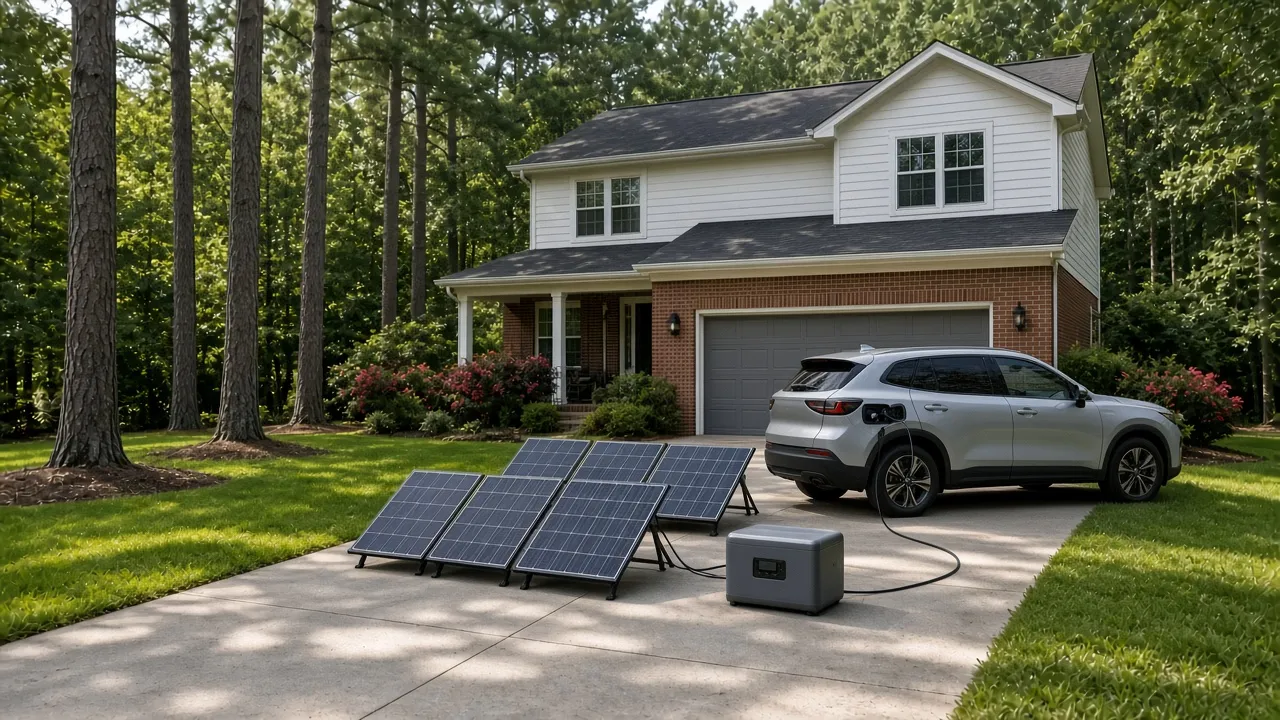
Portable solar EV charging cannot be judged by peak wattage alone. The useful question is how many kilowatt-hours reach the vehicle’s battery during the time and sunlight you actually have. That depends on the solar array, energy storage, conversion equipment, compatible charging equipment, and the vehicle—not one number in a headline.
This is a specification-reading guide for homeowners and small-business owners comparing portable solar charging with their usual charging arrangements. It is not a hands-on review, a product endorsement, or a forecast of charging performance in Atlanta.
Separate power, stored energy, and vehicle range
| Specification | What it describes | What it does not establish |
|---|---|---|
| W or kW | Power: the rate of energy transfer at a particular point in the system | Total energy collected over a day |
| Wh or kWh | An amount of energy, such as a battery’s stated storage capacity | The power available at its outlet or the energy ultimately reaching the car |
| Miles of added range | A range estimate based on energy and vehicle efficiency assumptions | A universal result for every vehicle, route, temperature, or season |
One kilowatt is 1,000 watts; one kilowatt-hour is 1,000 watt-hours. A steady 1 kW maintained for one hour transfers 1 kWh. That relationship is simple. Establishing whether a portable system can maintain that output is the part that requires evidence.
Keep a column for where each rating is measured. A solar-panel DC rating, an inverter AC output rating, and energy entering the vehicle battery describe different stages. They are not interchangeable even when the units look similar.
Read a real specification sheet without filling in the blanks
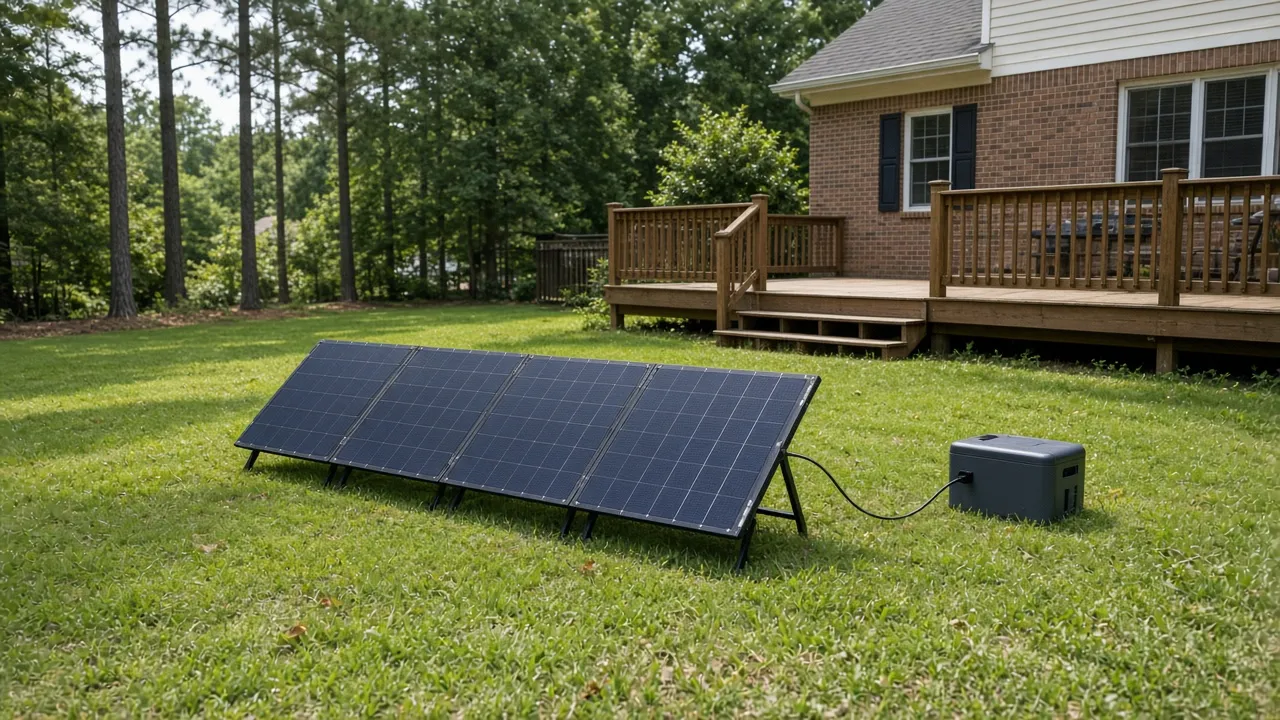
As of November 2026, the GoSun EV Solar Charger product page lists a 2,400 Wh lithium iron phosphate buffer battery, a 1,100 W peak solar figure, a separate 200 W continuous solar figure, and 110 V AC power-bank output. It also says roof crossbars and the EVSE charging cable are not included. These are manufacturer statements, not independently measured results.
The two solar-power figures need clarification before making a production estimate. Do not assume the 1,100 W figure is sustained vehicle charging, or guess what the separate continuous figure means. Ask the manufacturer to identify the measurement point, operating conditions, and sustained AC output available to the EVSE. A marketing specification alone does not answer all of those questions.
The same page describes energy passing through a buffer battery and inverter before Level 1 charging. It also advertises “up to 20 miles of range per day from pure solar charging.” That is a manufacturer claim, and the page text does not state the vehicle efficiency, sunlight, or battery assumptions behind it. None of these figures turns a solar peak rating into a guaranteed full-day energy delivery.
Work through an energy example—not a product prediction
The following numbers are deliberately hypothetical. They demonstrate the calculation only; they are not GoSun test results, Atlanta weather data, or an efficiency claim for any device.
- Choose a solar input assumption: a 1.1 kW array multiplied by four equivalent full-output hours gives 4.4 kWh before losses and system limits.
- Apply an explicitly assumed end-to-end factor: at an illustrative 70% delivery factor, 4.4 × 0.70 gives 3.08 kWh reaching the car battery.
- Use a vehicle-specific consumption assumption: at an illustrative 0.30 kWh per mile, 3.08 ÷ 0.30 gives about 10.3 miles of energy-equivalent range.
Change any assumption and the result changes. At only two equivalent full-output hours, the same arithmetic gives half the energy. The example is invalid for a real product if its controller, storage, inverter, or vehicle cannot support the assumed energy flow.
Four equivalent full-output hours are not four ordinary clock hours of daylight. For context, PVWatts documentation describes an hourly solar-resource model for estimating grid-connected PV production. That is not validation of a portable product or a prediction for a car parked under changing shade.
Questions about your site? Talk to Mason.
A buffer battery is neither extra sunlight nor unlimited output
A stated 2,400 Wh capacity equals 2.4 kWh of nominal stored energy. It does not mean the entire 2.4 kWh will reach the vehicle: the operating limits and losses in the path matter. Nor does it mean that 2.4 kWh is the maximum possible daily throughput if the battery can recharge and discharge again.
Conversely, adding the battery’s capacity to the day’s solar harvest can double-count energy. If sunlight charged the buffer that morning, releasing that stored energy later is part of that day’s solar flow—not another independent energy source. If the buffer started full from a different source, record that starting energy separately.
This distinction matters when judging a demonstration. A car accepting charge proves that a charging session started; it does not, on its own, establish how much solar energy was collected that day or how much was already stored.
Confirm the entire charging path
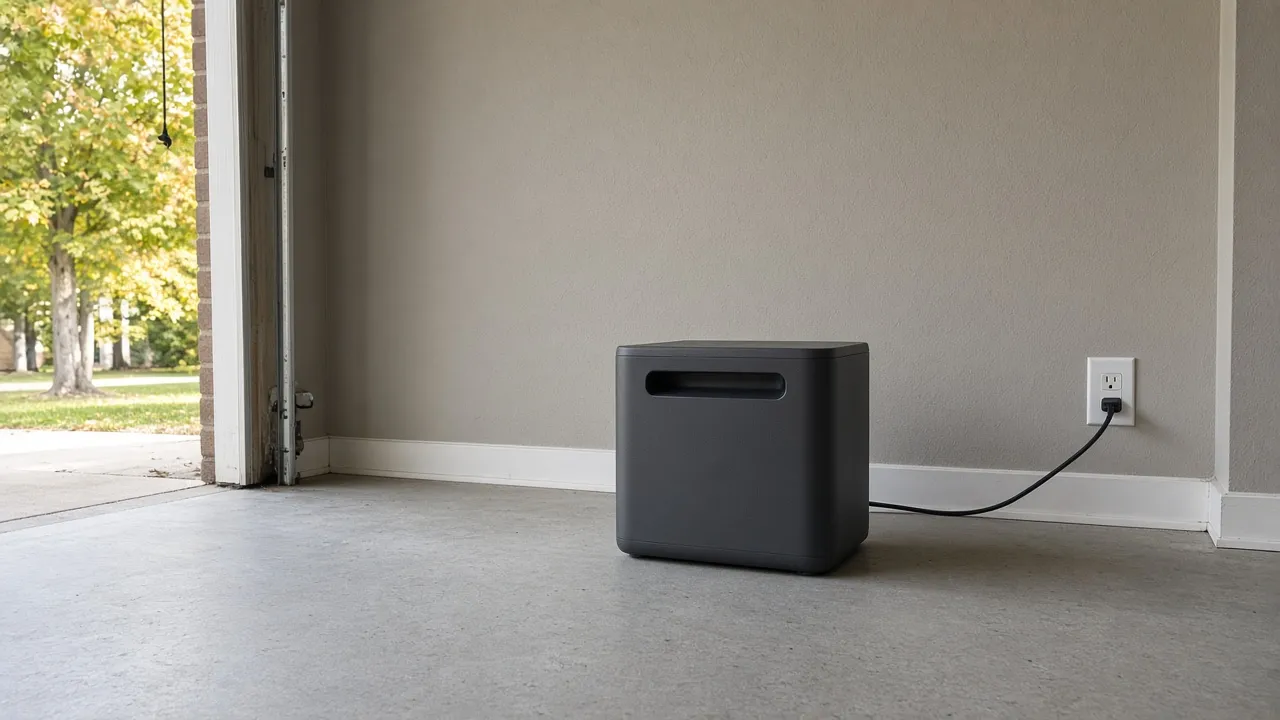
The U.S. Department of Energy’s charging overview distinguishes Level 1 AC charging from Level 2 and explains that charging time depends on both the vehicle and equipment. A solar power station with an AC outlet is not automatically a compatible EV charging system.
Before buying, request written answers to these questions:
- Which exact vehicle and EVSE combinations are supported, and what continuous AC output can the system provide?
- Does the system provide the grounding and protection the EVSE requires, without improvised modifications?
- How does charging restart if solar production falls or the buffer reaches its operating limit?
- Which components can remain outdoors, under what conditions, and which must stay protected?
- What evidence supports the advertised daily range, including vehicle, weather, panel position, starting battery charge, and losses?
Follow the equipment and vehicle manufacturers’ instructions. Do not defeat protective devices, improvise grounding connections, or feed a building through a wall receptacle. A portable EV charging setup is not permission to connect a battery or inverter to home wiring. Our guides to portable power stations versus home circuit backup and balcony solar power explain why the connection method matters.
Compare portable solar EV charging with the job you need done
For an Atlanta homeowner who needs dependable energy before a morning departure, compare expected usable kWh and the consequences of a poor solar day—not only purchase price or peak watts. For a small business considering occasional portable charging, write down who will set up, secure, monitor, and store the equipment. Identify the alternative charging plan when it is unavailable. If your business needs permanent chargers instead, see our small-business charger planning guide on parking use, capacity, ownership and quotes.
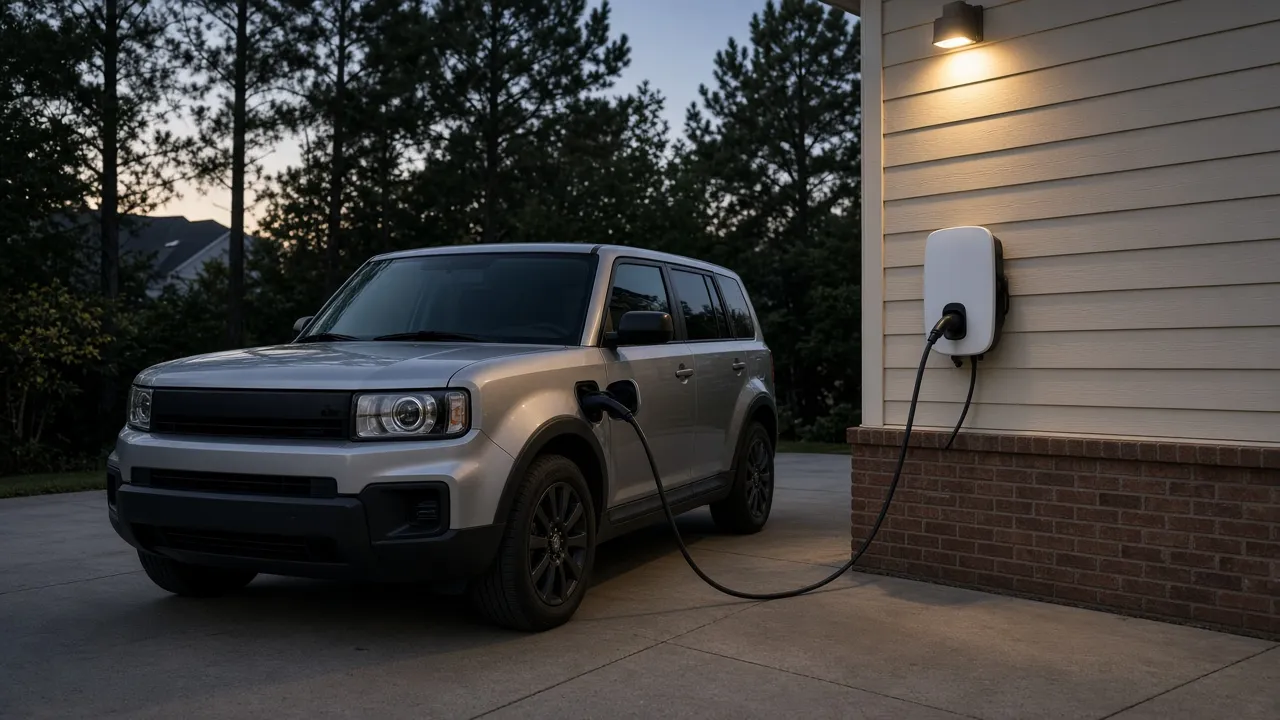
If the goal is dependable daily charging at home, a Level 2 charger on a dedicated circuit is a common arrangement, installed by a licensed electrician. Mason Electric’s home EV charger installation service starts with a review of your panel and your daily charging needs.
Bottom line: ask for a traceable energy budget from sunlight to the vehicle battery. If the available information gives only a peak wattage and a daily-range headline, the evidence is not yet enough to predict what it will do for your driving.
Planning EV charging at home? Talk to Mason about your panel and daily charging needs.