How to Tell if a Circuit Breaker Is Bad
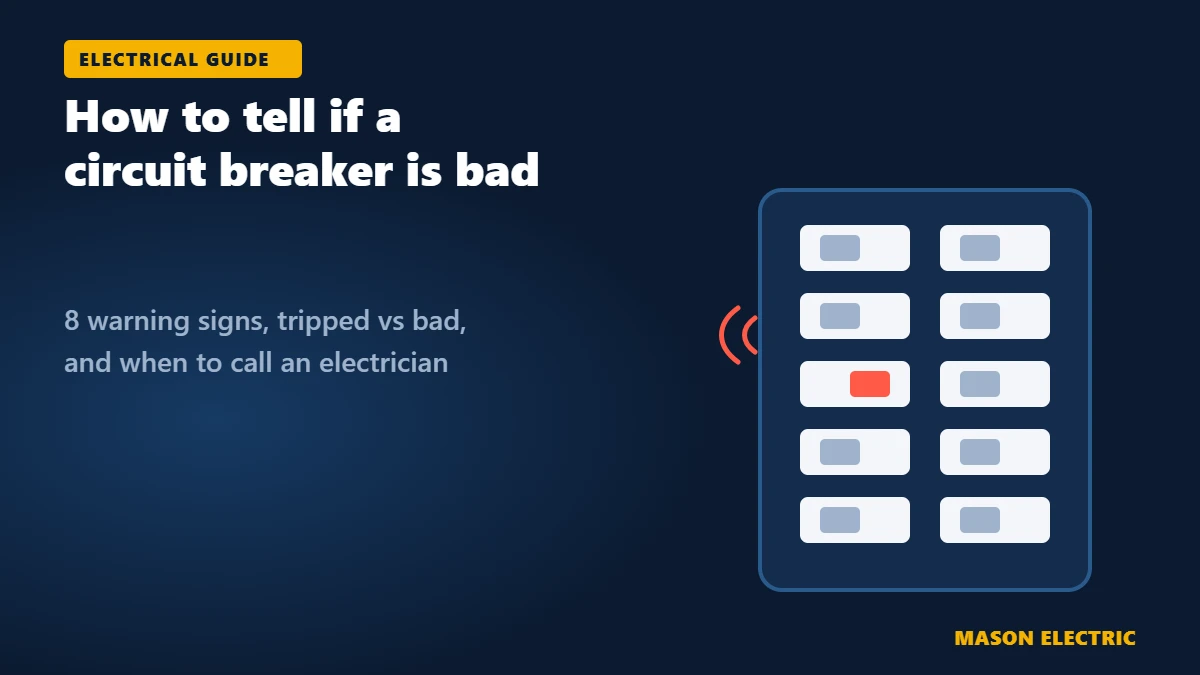
A breaker that keeps shutting off is not always a bad breaker. Most of the time it is doing its job and stopping an overload. But breakers do wear out, and a failing one can stop protecting your wiring. Here is how to tell if a circuit breaker is bad or just doing its job, what you can safely check yourself, and when to call an electrician.
Key takeaway
A breaker is likely bad if it will not reset, trips with nothing plugged in, feels hot, buzzes, smells burnt or shows scorch marks. Any heat, smell or burn mark means stop and call a licensed electrician.
Can a Circuit Breaker Go Bad?
Yes. A circuit breaker is a mechanical switch with a spring, contacts and a trip mechanism that reacts to heat and current. Over the years those parts can wear, weaken or get damaged by heat. A breaker can fail in two ways:
- It trips too easily. It shuts off with a normal load, or right after you reset it.
- It stops tripping when it should. This is the dangerous one, because the wire can overheat without the breaker reacting.
A failed circuit breaker of the second kind gives few warning signs. Defective circuit breaker symptoms like this are easy to miss, so heat and burning smells at the panel should never be ignored.
8 Signs of a Bad Circuit Breaker
These are the most common bad circuit breaker symptoms we see in North Atlanta homes. One sign alone does not prove the breaker is faulty, but two or more is a strong reason to have it tested.
Burning smell at the panel
A hot plastic or burning smell near the breaker box points to overheating. Turn off the main breaker if you can do it safely and call an electrician.
Scorch marks or melted plastic
Black or brown marks on the breaker, the panel cover or the wires are signs of arcing or heat damage.
Hot to the touch
A breaker can feel slightly warm under load. One that is noticeably hot compared to the others is a warning sign.
Buzzing or crackling
A faint hum can be normal. A loud buzz, sizzle or crackle from one breaker often means loose or burnt contacts.
It will not reset
If the handle will not stay in the on position, the breaker or the circuit has a problem.
Trips often with a light load
A breaker that trips with only a lamp or a phone charger on the circuit may be worn out.
Flickering or dim lights
Lights on one circuit that flicker or dim can point to a loose connection at the breaker.
Old or damaged breaker
Cracks, a loose handle, rust or water marks in the panel all mean the breaker should be inspected.
Tripped Breaker or Bad Breaker?
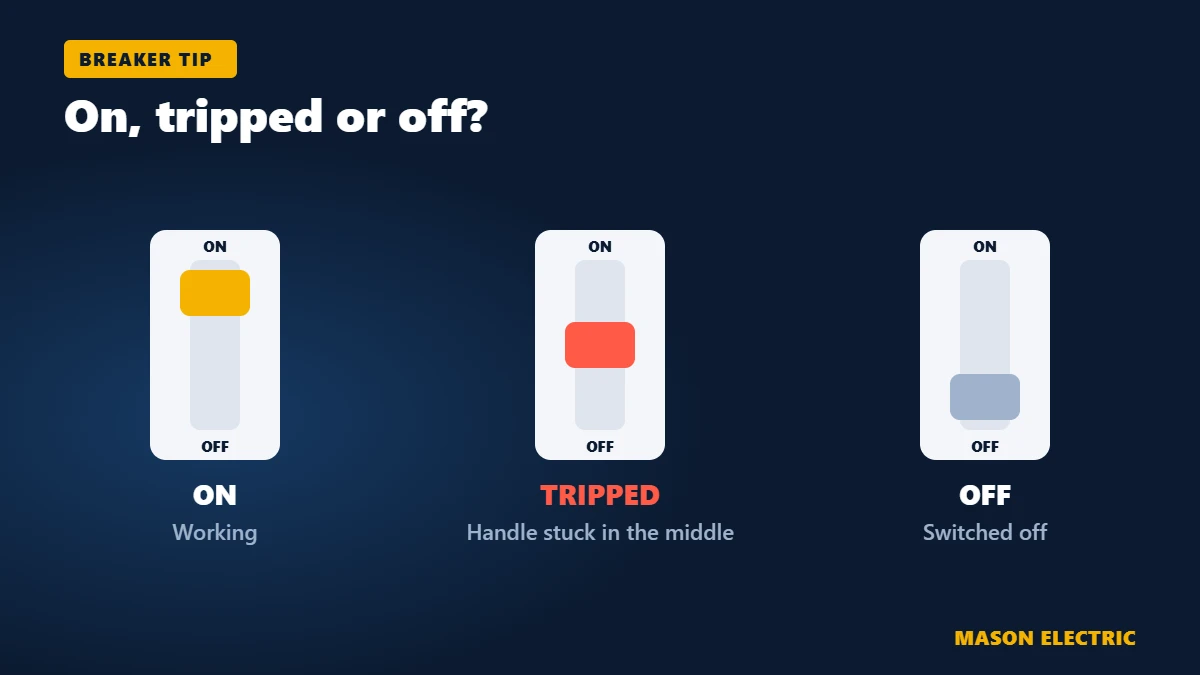
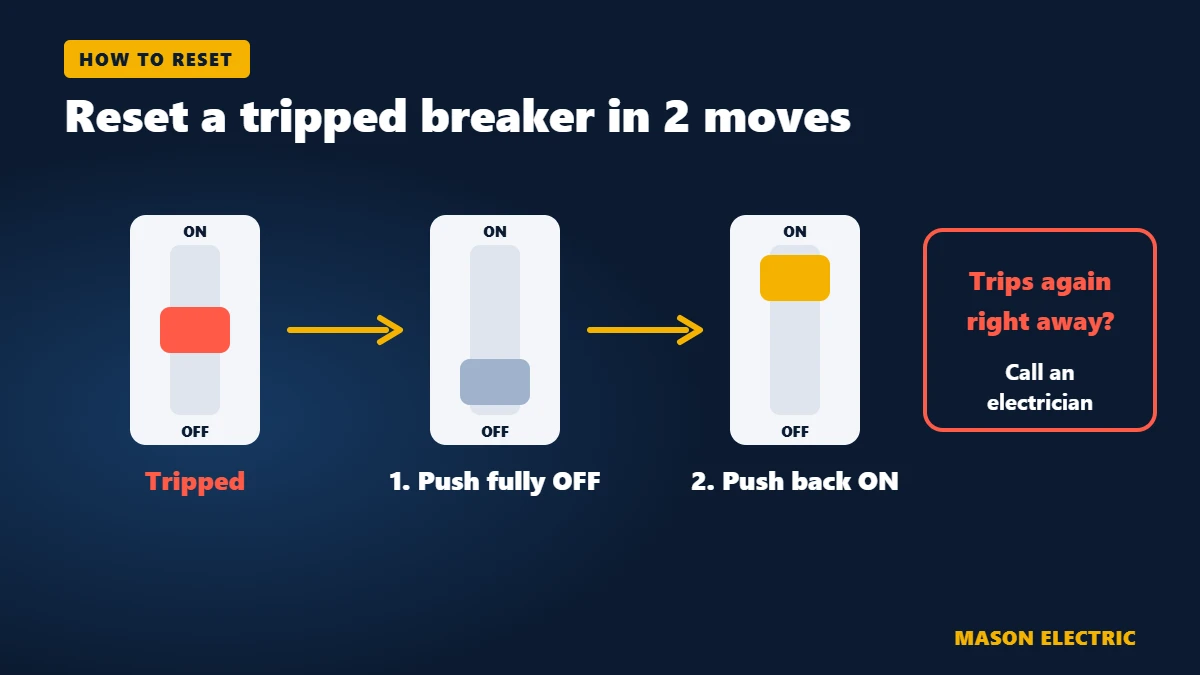
Before you assume the worst, make sure the breaker is not simply tripped. A tripped breaker usually sits in the middle position, between on and off. To reset it, push the handle firmly to off, then back to on.
| What you notice | Tripped breaker | Bad breaker |
|---|---|---|
| Handle position | Middle or off | May not stay on at all |
| After reset | Stays on until the next overload | Trips right away or with almost no load |
| Heat, smell or marks | None | Often hot, burnt smell or scorch marks |
| Sound | Quiet | Buzzing or crackling |
| Likely cause | Too many devices on one circuit | Worn parts, loose wire or heat damage |
If the breaker trips again only when a heater, a hair dryer or a microwave runs, the circuit is probably overloaded and the breaker is working. Moving that appliance to another circuit, or adding a dedicated circuit, usually solves it.
Can a Breaker Go Bad Without Tripping?
Yes, and it happens more than most people expect. Inside the breaker, the contacts can wear or burn while the handle still shows on. You may notice:
- Outlets or lights on one circuit that work only some of the time
- Lights that flicker when an appliance starts
- A warm spot on the panel cover over one breaker
- A breaker that never trips, even when the circuit is clearly overloaded
A breaker that does not trip on an overload is a fire risk. If you suspect one, have it tested rather than waiting for it to fail.
What Causes a Circuit Breaker to Go Bad?
- Age and wear. Springs and contacts weaken after years of use.
- Frequent tripping. Each trip stresses the mechanism, so a circuit that is overloaded every day wears its breaker faster.
- Loose connections. A loose terminal screw creates heat, and heat damages the breaker and the wire.
- Moisture and corrosion. Panels in garages, basements or on exterior walls can take on moisture.
- Wrong breaker for the panel. A breaker that does not match the panel may not seat well on the bus bar.
- Older panel lines with known problems. Some older panels, such as Federal Pacific and Zinsco, have a history of breakers that may not trip.
Safe Checks You Can Do at Home
You can learn a lot without opening the panel. Keep the panel cover on and your hands dry.
- 1
Unplug or switch off everything on the circuit.
- 2
Reset the breaker by pushing it fully off, then on.
- 3
Watch it. If it trips again with nothing running, the problem is the breaker or the wiring, not your appliances.
- 4
Add devices back one at a time. If it trips when one device starts, that device or the load is the likely cause.
- 5
Check for heat, smell and sound at the panel without touching anything inside it.
Do not remove the panel cover or test a breaker with a multimeter unless you are trained to do it. The wires that feed the panel stay live even when the main breaker is off.
How an Electrician Tests a Breaker
A licensed electrician can confirm whether the breaker, the wire or the panel is the problem. A typical visit includes:
- Voltage readings at the breaker and on the circuit
- A clamp meter check of the current the circuit draws
- A thermal check for hot spots on breakers and terminals
- A look at the bus bar, the wire insulation and the terminal screws
- A check that the breaker type matches the panel
Is It the Breaker or the Whole Panel?
Sometimes a bad breaker is a sign of a bigger panel problem. If several breakers run hot, the bus bar shows burn marks, or the panel is an older model with known issues, replacing one breaker will not fix it. In that case, an electrical panel replacement or upgrade may be the safer choice.
GFCI and AFCI Breakers Can Go Bad Too
GFCI and AFCI breakers have a test button. Press it with the circuit on: the breaker should trip right away. If it does not trip, or it will not reset after the test, it may be faulty. These breakers can also trip because of a real ground fault or arc fault on the circuit, so a test by an electrician is the best way to know which it is.
Circuit Breaker FAQs
Can a circuit breaker go bad?+
Yes. Breakers wear out from age, heat, loose connections and repeated tripping. A breaker that will not reset, feels hot or smells burnt should be checked by an electrician.
How do you know if a breaker is bad or just tripped?+
A tripped breaker sits in the middle position and resets when you push it fully off and then on. A bad breaker will not stay on, trips with almost no load, or shows heat, buzzing or burn marks.
Can a breaker go bad without tripping?+
Yes. A worn breaker can stay on while its internal contacts fail, which can cause flickering lights, dead outlets or heat at the panel. The opposite failure is worse: a breaker that no longer trips when it should.
Can a bad breaker cause lights to flicker?+
It can. Loose or burnt contacts inside the breaker, or a loose wire on its terminal, can make lights on that circuit flicker or dim.
What causes a circuit breaker to go bad?+
Common causes are age, overloaded circuits, loose terminal screws, heat inside the panel, moisture and corrosion, and breakers from older panel lines with known problems.
How long do circuit breakers last?+
Many breakers last for decades. Age alone is not a reason to replace one, but older breakers that trip often, run warm or sit in a panel with water damage should be inspected.
Is it safe to replace a circuit breaker myself?+
We do not recommend it. Removing the panel cover exposes parts that stay live even with the main breaker off. A licensed electrician can test the breaker, match the right type for your panel and check the wiring.
How much does circuit breaker replacement cost?+
It depends on the breaker type and the condition of the panel. A standard breaker costs less than an AFCI or GFCI breaker, and a panel with damage may need more work. Mason Electric gives free estimates.
How do you know if the main breaker is bad?+
The main breaker controls power to the whole house. Signs of a bad main breaker include the whole house losing power while the utility is still on, a main breaker that will not reset, or heat, buzzing or burn marks at the top of the panel. Call an electrician. Work on the main breaker often needs the utility to disconnect power first.
Think you have a bad breaker?
Mason Electric is a licensed Atlanta electrician based in Alpharetta. We test and replace breakers in Alpharetta, Milton, Johns Creek, Roswell, Duluth and Cumming. See our circuit breaker replacement service or call (678) 599-8706.
Mason Electric LLC, 5020 Morton Ferry Cir, Alpharetta, GA 30022 · (678) 599-8706