Exit Sign & Emergency Lighting
A glowing EXIT sign is only part of the job.
An exit sign goes dark during a power interruption. A battery light flashes briefly, then fades. Or an inspection report calls for changes you have not priced yet. Start with the equipment, power supply, and route people actually use to leave the building.
What needs attention at your property?

An existing unit fails
A dark sign, damaged housing, weak battery, or failed test needs an equipment and supply check. Describe what failed and whether other units on the same area have power.
The layout has changed
New partitions, doors, or tenant use can change the planning question. Review the approved exit route with the responsible building or fire authority before deciding fixture locations.
You need a replacement scope
Separate like-for-like equipment work from new wiring, additional emergency illumination, and inspection corrections. That distinction makes the estimate easier to compare.
Exit identification and path illumination do different jobs.
Exit identification
An illuminated EXIT sign identifies a way out. It does not automatically provide emergency illumination along the escape route.
Path illumination
Emergency lights illuminate the route when normal power is lost. Combination units can include a sign and light heads, but placement and coverage still need review.
Equipment selection
Match equipment to occupancy, mounting height, environment, and required coverage. Check the power supply and compatible parts for existing battery units.
Model-specific testing
Lithonia’s LQM documentation describes manual and optional automated testing. Confirm the exact model’s features before ordering.
Choose equipment around the route, not just the fixture count.
| Option | Useful when | Confirm before ordering |
|---|---|---|
| Battery exit sign | The exit needs illuminated identification and backup capability. | Face direction, arrows, mounting, voltage, battery configuration, and local approval. |
| Emergency light unit | A section of the egress route needs emergency illumination. | Light distribution, run-time specification, aiming, environment, and power supply. |
| Combination sign and heads | The mounting point can serve identification and nearby illumination. | Actual coverage and whether remote heads are permitted by that model. |
| Emergency driver or central system | The design uses selected normal fixtures or a building backup system. | Fixture compatibility, system design, testing method, and responsibility for controls. |
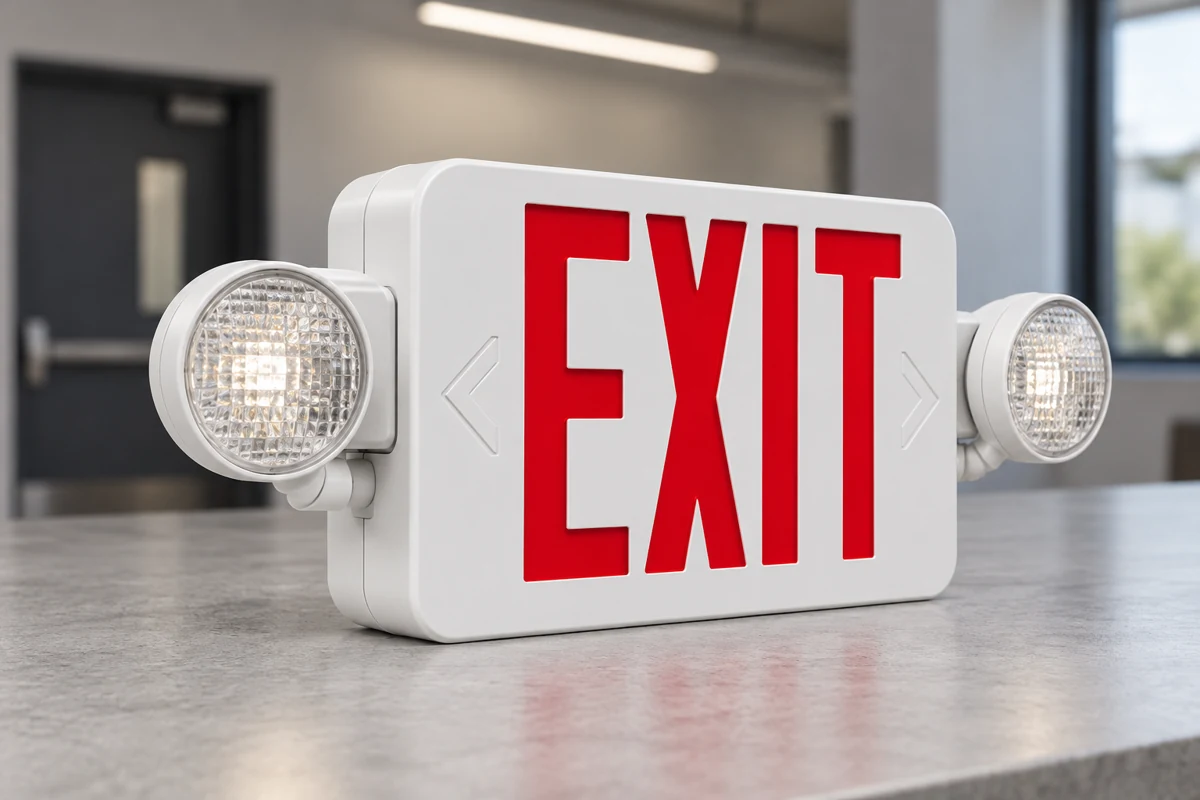
Two equipment options to discuss before ordering
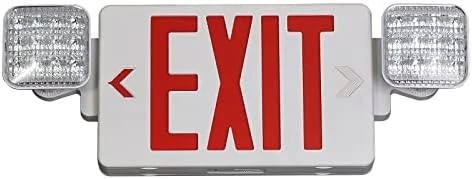
TANLUX combination EXIT sign
This combination unit brings illuminated red EXIT lettering and two emergency light heads into one fixture. It can be considered when the mounting point needs both exit identification and nearby emergency illumination.
The listing specifies 120/277V operation and a battery backup rated for at least 90 minutes. Confirm the selected variant, mounting arrangement, direction arrows, and actual route coverage before ordering.
View product on Amazon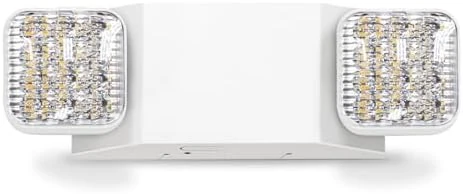
Dual-head LED emergency light
This standalone fixture provides emergency illumination without an EXIT sign. Its two adjustable LED heads can be aimed toward the route, making it a different option from a combined sign-and-light unit.
The listing specifies hardwired 120/277V operation and a 90-minute battery backup. Review the mounting surface, wiring, test method, and required light coverage before selecting locations.
View product on AmazonTesting needs more than a quick flash.
A brief push-button check can reveal an immediate problem. It does not establish that the battery will sustain the required duration or that the entire route receives adequate light. Testing should follow the applicable requirements and the exact equipment instructions, with failures recorded for correction.
Agree who will maintain the test record and perform future checks. A useful handoff identifies the installed model, battery or consumable information, test method, and any unresolved conditions. Self-testing equipment can simplify part of that work, but a feature label is not a substitute for checking the instructions.
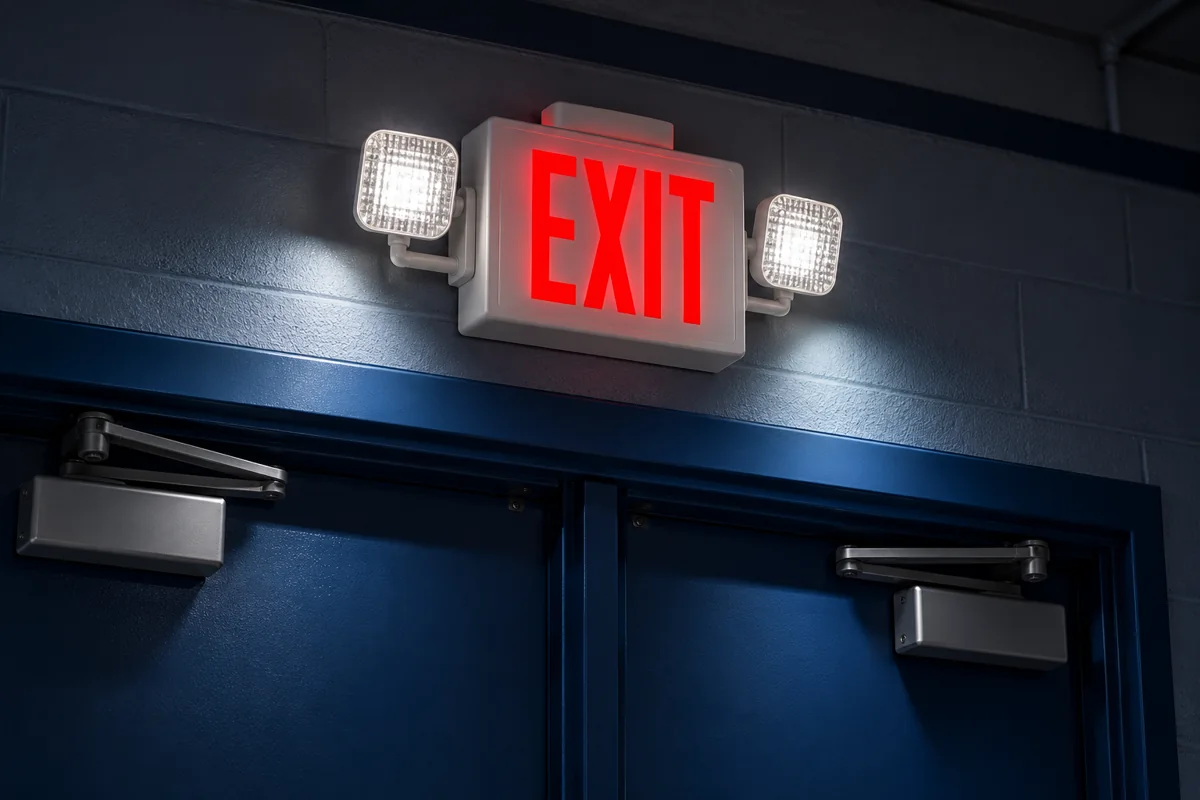
Need help with exit signs or emergency lighting?
Discuss the equipment, testing, and electrical work for your property.
An inspection note is the best starting point for a correction.
Bring the report or approved plans, not only a verbal description of the issue. The scope may involve failed equipment, insufficient illumination, wrong placement, or wiring changes. Replacing a sign cannot resolve every one of those conditions.
Georgia’s current construction-code page identifies the state framework and directs life-safety questions to the State Fire Marshal. Confirm the applicable occupancy and approval path with the authority for the property. A service estimate does not guarantee an inspection result.
Environmental ratings also matter. Lithonia’s wet-location emergency-unit information illustrates why an exterior location needs equipment selected for that environment rather than a standard indoor unit.

Define the estimate before arranging access.
The main cost variables are the number and type of units, mounting height, existing wiring condition, new circuit routes, replacement compatibility, and required testing or inspection coordination. Include ceiling access, occupied-business hours, and any areas that cannot be interrupted during the visit.
For broader electrical changes, review the Mason Electric services directory. Keep the lighting correction scope clear so required wiring and unrelated tenant improvements are priced separately.
Questions from property managers.
Can you replace only the battery?
Sometimes. The exact battery must be compatible with the unit, and the charger, lamps, housing, and supply must also be in suitable condition. Send the equipment model and describe the failed test before buying a battery.
Does an EXIT sign light the whole escape route?
Not necessarily. Exit identification and emergency illumination serve different purposes. A combination unit may help with both, but coverage depends on the selected equipment and approved layout.
What if the test button works but the light dies during an outage?
The momentary test may not reveal weak battery capacity, charging problems, or other faults. Request an assessment and a test appropriate to the equipment and applicable requirements.
Can I choose red or green letters myself?
Confirm the requirement for the property with the responsible authority. Product options, existing approved design, and local direction should guide the order.
Can the work happen outside business hours?
Include operating hours and access restrictions in your request. Scheduling and planned interruptions can be discussed after the scope is known.
Electrical service across Atlanta Metro
Mason Electric serves Atlanta, Alpharetta, Milton, Roswell, Duluth, Cumming, and Johns Creek. Include your address and ZIP code to confirm scheduling and the authority responsible for the property. City or county jurisdiction and the actual work determine the approval process. Serving Alpharetta? See our Electrician in Alpharetta page.
For properties within Atlanta, use the City of Atlanta’s Office of Buildings information to reach the relevant permitting department. Confirm the project-specific permit and inspection steps before work is scheduled.
Get the correction scope clear.
Send the inspection note, floor-plan excerpt, or failed unit photos. We can discuss equipment, wiring, access, and the next practical step.